

Emotional intelligence (E.I.) is not just a buzzword. It is a core part of personal growth, creativity, and learning. The ability to recognize, name, and work through emotions shapes how we respond to challenges, connect with others, and understand ourselves more clearly.
Think about the everyday moments when overwhelm becomes a roadblock, or when frustration makes creativity feel out of reach. This is where emotional awareness becomes especially valuable. As we become more skilled at noticing what we are actually feeling, we also begin to understand how those emotions influence our decisions, confidence, and ability to keep going.
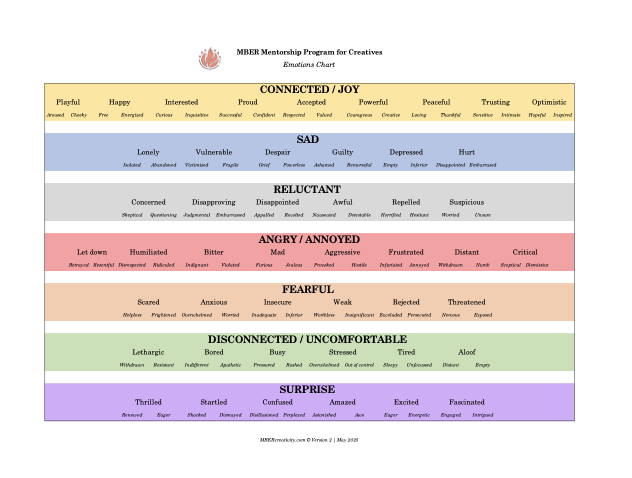
The Emotions Chart is more than a list of feeling words. It is a practical tool that encourages mindfulness and greater specificity in how we label emotional experiences. Instead of stopping at broad words like “good,” “bad,” or “stressed,” learners can begin to identify more nuanced emotional states with clarity and precision.
This free resource is designed to support not only music learners, but anyone developing self-expression, self-awareness, and emotional language. By building a richer emotional vocabulary, students and families can create a stronger foundation for resilience, reflection, and creative growth.
Whether someone is taking their first steps in music or simply learning how to navigate their inner world more clearly, emotional awareness can make the path forward feel more grounded and manageable. My hope is that this chart offers a fresh lens for understanding emotions — one that supports both creativity and confidence along the way.
Download the Emotions Chart
If you would like a simple visual tool to support emotional awareness at home or in the classroom, you can download the free Emotions Chart below.
It is designed to help children, students, and adults move beyond broad terms like “good” or “bad” and build a more specific emotional vocabulary.
 Download the Emotions Chart
Beyond “Good” and “Bad”: The Power of Emotional Labeling
Saying we feel “good” or “bad” rarely tells the full story. Broad emotional labels can be useful at first, but they often leave out the nuance that helps us actually understand what is happening beneath the surface. Emotional labeling invites us to become more specific, and that specificity can be transformative.
You may have heard the phrase, “name it to tame it.” When we are able to identify an emotion more accurately, we create a little more distance from the overwhelm and a little more clarity around what might be causing it.
This is especially important for children. When a child can say they feel “excited” instead of simply “happy,” or “anxious” rather than just “bad,” they begin to build a stronger bridge to self-awareness. That shift from vague language to more precise language opens the door to deeper communication, better reflection, and greater emotional confidence.
The Emotions Chart is designed to support that process. Rather than stopping at a few broad feeling words, it helps learners explore categories like joy, fear, reluctance, anger, and surprise with more detail and nuance. In doing so, it becomes easier to find the words that genuinely match the inner experience.
Giving an emotion a clearer name can reduce the sense of chaos around it. Feelings become less mysterious and more manageable. For young creatives, music students, and anyone developing self-expression, a more precise emotional vocabulary can be just as valuable as technical skill. It creates a stronger foundation for resilience, reflection, and meaningful creative growth.
The Symbiosis of Emotional Intelligence and Creative Expression
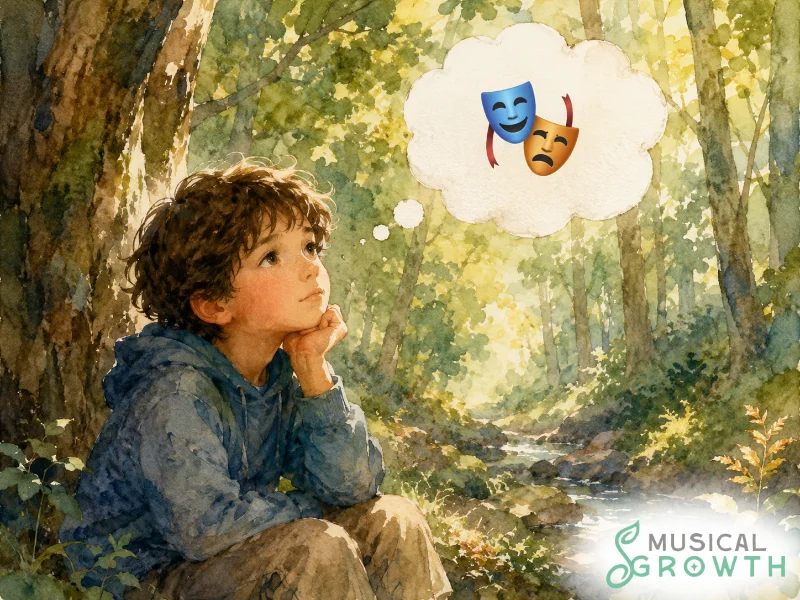
Emotional intelligence and creativity are deeply connected. When we better understand our emotional world, we gain clearer access to the thoughts, feelings, and inner experiences that often shape creative work. For young music students and other creative learners, emotional awareness can make expression feel more authentic, grounded, and meaningful.
Naming an emotion can also reduce the judgment that often surrounds it. When someone can recognize, for example, that they feel sad, frustrated, or uncertain, that feeling becomes easier to observe rather than simply react to. Instead of being swept away by the emotion, they can begin to notice how it shifts, what it is connected to, and how it may be expressed in a healthy way.
This matters in every creative process. Whether a student is composing a melody, interpreting a piece of music, drawing, writing, or improvising, emotional clarity adds depth. Creativity is not only about technique. It is also about meaning, and emotional intelligence helps learners connect more honestly with what they are trying to express.
Struggles in creativity are not always about a lack of talent. Often, the difficulty lies in not yet knowing how to identify or communicate what is happening internally. The Emotions Chart can support this process by acting as a bridge between feeling and expression. Words like “frustrated,” “hopeful,” “overwhelmed,” or “inspired” can help transform inner experience into something more workable and creative.
As emotional intelligence develops, so do confidence and resilience. Creative challenges begin to feel less like personal failures and more like part of the learning process. With greater emotional awareness, students are often better equipped to stay present, adapt, and keep moving forward in their artistic growth.
Implementing the Emotions Chart: A Guide for Parents and Educators
Emotions can be difficult for children to understand, especially when they are still developing the language to describe what they feel. This is where parents, caregivers, and educators play an important role. The Emotions Chart is not only a resource for children; it is also a tool adults can use to support emotional growth in simple, practical ways.
At the end of the day, during quiet time, or before a lesson begins, invite a child to choose a word that best reflects how they feel.
In a classroom, studio, or home lesson area, the chart can become a normal part of reflection rather than something only used in hard moments.
The goal is not to force emotional disclosure, but to make honesty feel supported, calm, and welcome.
Adults can help by responding calmly, modeling emotional vocabulary themselves, and showing that emotions can be named without shame or urgency. This gives children permission to explore what they feel without assuming that every emotion needs to be fixed immediately.
Used consistently, the chart can help children notice patterns, communicate more clearly, and feel less overwhelmed by what they are experiencing. In time, that emotional clarity can support stronger resilience, better self-expression, and more confidence in both creativity and learning.
Inviting Emotional Growth: A Gentle Call-to-Action
Emotional growth does not happen all at once. It develops gradually, through language, reflection, relationship, and practice. The Emotions Chart is meant to support that process by offering a clearer way to notice, name, and understand what is happening internally.
Rather than thinking of this chart as just another printable resource, it may be more helpful to see it as an invitation. It offers parents, educators, and learners a practical starting point for approaching emotions with more curiosity, clarity, and care. In doing so, it can help foster resilience, creativity, and a stronger sense of self-awareness over time.
Explore the MBER course for deeper guidance on emotional intelligence and creativity in parenting.
Whether you are a parent hoping to better understand your child’s inner world or an educator wanting to create a more emotionally supportive learning environment, this chart can serve as a simple but meaningful tool. It helps create space for more honest conversations and gives children a stronger vocabulary for describing what they feel.
Emotional awareness is not about rushing through feelings or trying to fix them immediately. It is about learning how to recognize them, understand them, and respond with greater steadiness. That kind of awareness can become a powerful foundation for both creativity and learning.
Take the Emotions Chart with you
If this article has sparked reflection, you can download the free Emotions Chart as a practical next step.
It is a simple resource to return to whenever you want to support emotional language, self-awareness, and more grounded conversations around creativity, learning, and growth.
Download the Free Chart