Tag: types of yoga

  • Kundalini Energy Benefits – Overview

    Kundalini Energy Benefits – Overview

    Out of the 14 types of yoga styles, there is one, in particular, that seems to have amazing, almost “magical” powers of releasing innate energy and is often referred to as an “awakening.”
    Through this article, I hope to introduce you to Kundalini energy benefits to convince you to try it yourself or at the very least, do some more research!

    This article’s organization:

    • Overview
    • Historical Quotes
    • The Serpent Power
    • Benefits of Kundalini Yoga

    Overview

    Kundalini roughly translates to “coiled one,” referring to the serpent energy found at the base of the spine.

    This primal energy is released by accessing it through this form of yoga. It is said the very energy of consciousness itself is awakened after 40 to 120 days of consistent practice. With a combination of meditations, poses, and mindfulness, a yogi can be transformed and all self-imposed limitations are broken.

    Kundalini is gaining popularity in New York City and Los Angeles for many reasons besides physical exercise. Many use this form of yoga practice as a “tool” to find your “Higher Self” or the actualized version of yourself.

    Most Westerners associate the word, “yoga,” with exercise but to many ancient traditions it was far more than that – yoga is a sacred spirit-body connection (at least it can be). One of the best examples of this connection between mind and body is Kundalini, thus the reason behind its popularity. So this trendy new spiritual yoga style does have more cultural tradition rooted in its very core than one might think.

    Historical Quotes

    It is said that the first writings mentioning Kundalini were from a sacred Vedic collection of writings named Upanishads that date back to around 1,000 B.C.E. This form of yoga was treated as advanced “education” and was kept secret for thousands of years because “the public was not prepared to access such powerful knowledge.”

    It was only until one holy Sikh rebel, named Yogi Bhajan, ran from Punjab, India, to Toronto, Canada in 1968 to begin teaching Kundalini to the Western world and the public – thank goodness for him.

    Gyaneshwara, a famous saint, wrote about Kundalini in 1275 A.D.:

    “Kundalini is one of the greatest energies. The whole body of the seeker starts glowing because of the rising of the Kundalini. Because of that, unwanted impurities in the body disappear. The body of the seeker suddenly looks very proportionate, and the eyes look bright and attractive, and the eyeballs glow.”

    About 200 years later, Guru Nanak Dev also mentioned Kundalini:

    “God had made this human body a house with six Chakras and has established the light of spirit in it. Cross the ocean of Maya and meet the eternal God who does not come, who do not go, who neither takes birth nor dies. When your six Chakras meet in line, Surati (Kundalini) takes you beyond distortions.”
    The Serpent Power

    Shri Ramana Maharshi, for example, believes that Kundalini is the natural energy of this universal consciousness. This “energy” is present in every person. It is only through meditation, pranayama breathing, and mantra chanting that this natural energy can be uncovered. Once uncovered, it can cause a form of enlightenment and bliss.

    The word “Kundalini” roughly translates to “coiled one” and is said to lie coiled at the base of the spine in a dormant state – much like a sleeping serpent waiting to be awakened. At the base of your spine is a triangular bone called the sacrum. The Greeks had even attributed supernatural powers to this bone. One morbid example is one of their observations: that the sacrum bone is the last bone to be destroyed when a body is burnt (very nasty example, but still interested – I hope!).

    The sacrum bone (which translates to sacred bone) is also associated with nadis (energy channels), chakras (psychic centres), prana (subtle energy), and bindu (drops of essence). Altogether they make up what is known as the “subtle body.”

    Benefits of Kundalini Yoga

    Although the aim of Kundalini Yoga is to awaken the coiled energy at the base of the spine, the practice itself provides many benefits that can be enjoyed while striving to achieve a full awakening. With the help of effective breathing technique and gentle movements, this form of yoga can greatly reduce stress and bring happiness into your life (as a few examples).

    The benefits of Kundalini include:

    • Reduced Stress
    • Strengthened Core
    • Present Moment Awareness
    • Improved Lung Capacity
    • A Sense of Peace and Joy

    Reduced Stress

    Kundalini focuses greatly on yogic breathing (pranayama) and there are quite a few techniques that provide varying positive effects on the mind and body.

    Many of these techniques encourage long, deep breaths, which help to relax the body and melt away stress. The movements that are practiced also help to stretch and loosen muscles. Simply relieving tension in the body can greatly reduce your stress levels and improve your mood.

    Strengthened Core

    Many Kundalini movements and techniques work the core or abdominal muscles. “Breath of fire,” in particular, works the navel center. A strong core is essential in yoga and helps to improve your posture in daily life.

    The navel chakra is also associated with emotions, so strengthening your core muscles can go a long way in helping you better control your emotions and handle life’s many triggers of stress.

    kundalini - awareness

    Present Moment Awareness

    Part of the reason why so many people are drawn to this particular type of yoga is the fact that it allows them to bring themselves into the present moment easily. Left-nostril “breath of fire” breathing and other movements associated with Kundalini yoga, all require great concentration and awareness to execute with proper form.

    Practitioners find that they can leave their past behind and forget their anticipation for the future while practicing Kundalini yoga in class sessions. Being in the present moment allow you to calm the mind, slow thinking, and appreciate what you already have in life.

    A Sense of Peace and Joy

    Much like other forms of yoga, Kundalini improves the practitioner’s overall emotional well-being. Meditation plays a major role in this practice, which keeps the mind grounded and provides peace of mind.

    Taking time out of your day to relax and calm your mind will bring forth great joy and happiness, primarily due to the stronger balance you’ll have between the body and the mind.

    Conclusion

    Kundalini is far more sacred than most people might realize, which can be said about yoga altogether. The Western world treats it as a physical aerobic exercise (the reason behind the popularized Vinyasa style), but there is so much potential in balancing body, mind, and spirit.

    The sad part is, the spiritual side of yoga is not hidden at all – it is mostly just overlooked.

    But, if you’re curious in participating in this ancient form of awakening innate energy, Kundalini might offer some extraordinary benefits not found in traditional Western practices.

    I hope this article helped introduce you to the joys of Kundalini yoga. I invite you to read more articles if you’re interested in learning more about yoga and related materials:

    Have you ever tried Kundalini yoga before? If you have, what is your opinion of it? If you haven’t, do you think you’d ever try?

    Let me know in the comments below! I’m excited to hear your thoughts.

    Thanks for reading everyone. And good luck with all your yoga activities!

    Chase

    March 2018

    MusicalGrowth - Site Logo

    Sources

    Houston Methodist Orthopedics

    Wikipedia – Dnyaneshwar

    Sh#t Your Ego Say – Kundalini

    Kundalini Research Project

    The Secrets of Yoga – Kundalini

  • Types of Yoga Styles – The Top 14

    Types of Yoga Styles – The Top 14

    *Originally published 3/6/18. Updated 7/20/18.


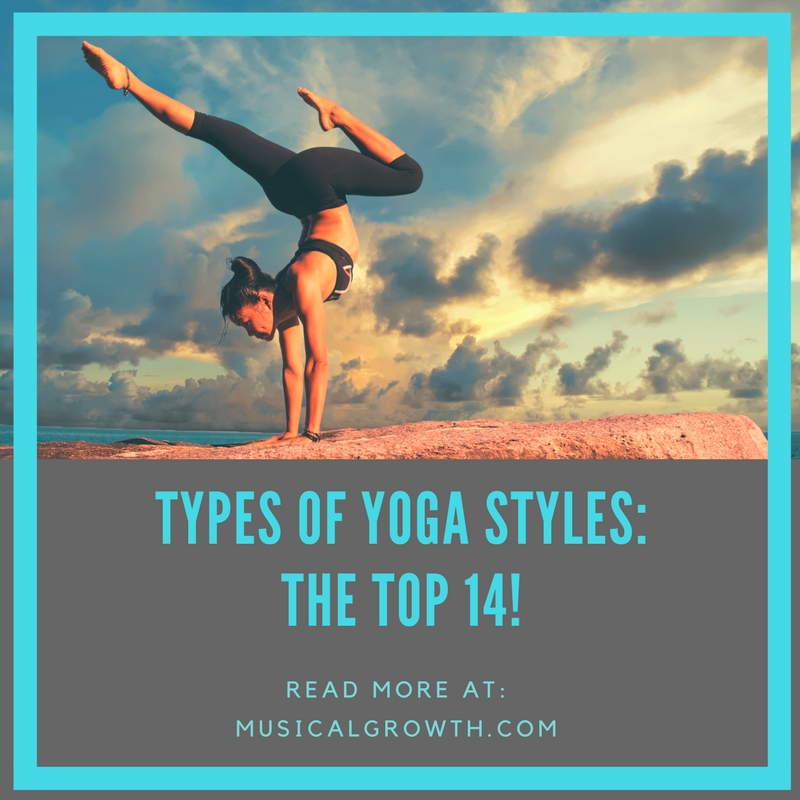
    There’s a lot of confusion about yoga, so to enlighten everyone with one article, here are all the most popular types of yoga styles you need to know about.

    14 Types of Yoga Styles

    If you have questions with regard to a specific style, I go into further detail past this introductory list. So keep reading!

    Top 14 Types of Yoga Poses:

    1. Anusara
      • A heartfelt and accepting style open to less standard positions.
    2. Ashtanga
      • Rapid and flowing from one pose to another linked by the breath.
    3. Bikram
      • (a.k.a. Hot Yoga) 90-minute yoga session consisting of 26 postures repeated twice in a sauna set at 105º F and 30 to 50% humidity.
    4. Hatha
      • Basic and classical approach to yoga.
    5. Iyengar
      • Purist style (a.k.a. Furniture Yoga), where straps, blocks and boards are used to help gain perfectly aligned positions.
    6. Jivamukti
      • Translates to “liberation while living.” Pushes the physical limits and refer to traditional spiritual elements (chants, ancient scripture, etc.).
    7. Kripalu
      • Three-part practice with specific goals in learning and accepting your body.
    8. Kundalini
      • A fluid style of constant movement to release deep energy and invigorate.
    9. Prenatal
      • A yoga-style specifically catered to expectant or post-birth mothers to help strengthen muscles in a way that quickly returns them to normal after birth.
    10. Restorative
      • Focused on relaxation and simplistic poses meant to psychically cleanse with four to five simple poses.
    11. Sivananda
      • A style based on the philosophy of a healthy yogic lifestyle with twelve basic asanas and variations.
    12. Viniyoga
      • An individualized and adapted practice meant to decrease the chance of injury through PNF (proprioceptive neuromuscular facilitation).
    13. Vinyasa (Power)
      • A Westernized ashtanga system adapted for active, athletic, and aerobically geared yogis.
    14. Yin
      • (a.k.a. Taoist Yoga) A system that focuses on quiet, meditative yoga poses meant to lengthen connective tissues through gravity-led relaxation.

    These fourteen styles are extensively used throughout the West.

    The rest of this article will go into more detail for each style in terms of the origin of the name, what it’s about, the history, and the benefits.

    I hope this helps widen your horizons as far as your yoga experience! Few know about the fact yoga has so many styles. Yoga is not just “yoga,” each class utilizes different poses and postures from different styles.

    Be sure to read over each section! I’ve written down everything you need to know about each of these different yoga styles!

    1. Anusara

    Roughly translates to “flowing with grace,” “going with the flow,” or “following your heart.”

    Anusara

    Known as a modern-day Hatha yoga system founded in 1997 by John Fiend. The premise that we are all inherently good, this yoga style highlights the importance of body alignment, the balance of heart and mind, circulation, good health and well being.

    The benefits of Anusara yoga includes an improved balance of heart and mind, strengthened body, improved flexibility, and faster healing injuries. Balance is the main goal.

    2. Ashtanga

    Roughly translates to “eight-limbed yoga.”

    Ashtanga

    Ashtanga yoga was originally recorded by the sage Vamana Rishi and was handed down eventually into the hands of Pattabhi Jois who began teaching it at the Ashtanga Yoga Research Institute in 1948. Ashtanga, however, can be traced back to 200 B.C.E.

    The benefits of the Ashtanga style includes internal cleansing, detox, and improve the body (to feel healthy, light and strong). This system incorporates movements from vinyasa and tristhana.

    3. Bikram

    Generally known as “Hot Yoga.”

    Bikram Yoga

    Created in 1972 by Bikram Choudhury (hence, the name) where basic hatha yoga techniques and variations are set in 105º F sauna with 30 to 50% humidity. With 26 postures repeated twice, this style of yoga is not for the faint-hearted.

    The benefits of Bikram yoga include improved circulation, improved flexibility (ligaments, tendons, muscles, etc.), and restoration of all systems (including organ function and muscle fiber oxygenation).

    4. Hatha

    Roughly translates to “forceful,” though “forceful” doesn’t really apply. Hatha is a very broad term applied to any physical yoga styles (which includes everything on this list).

    Hatha Yoga

    At the time of the term’s origin (estimated around the 12th century), Hatha yoga was more strong in comparison to the other more subtle practices used in health and balance (such as meditation).

    The benefits of hatha yoga are broader because it is less specific in nature. If you want a gentle introduction to physically and mentally challenging yoga, consider hatha classes.

    5. Iyengar

    Known as the Furniture Yoga.

    Iyengar Yoga

    This form of yoga makes use of props (belts, blocks, blankets, etc.) to help the student perform positions accurately while minimizing the risk of strain or injury. B.K.S. Iyengar established this form of yoga in the 1970’s and are derived from Anusara and Forrest Yoga.

    The benefits of yoga include accessibility to both young and old, stress relief from modern-day life, promotion of physical and spiritual balance.

    6. Jivamukti

    Roughly translates to “seat, connection,” referring to the relationship to the Earth.

    Jivamukti

    Founded in 1984 by Sharon Gannon and David Life as a philosophy based expression of physical and emotional connection to the Earth and all other beings. With the connection to ancient teachings of yoga, this style is a great introduction for beginners for both the physical aspect and the ideology of yoga-thought.

    The benefits of Jivamukti yoga includes an improved connection between mind and body, improvement in one’s relationships, a dissolution of the sense of separateness, and the awareness of the oneness of being through the discovery of lasting happiness.

    7. Kripalu

    Roughly translates to “the compassionate one,” named after the teachings of Swami Kripalvanada.

    Kripalu

    Founded by Amrit Desai in the early 1900’s from the inspiration of his guru’s, Kripalvananda, life and teachings. This style of yoga plays with body, mind, and energy by working on a musculoskeletal level (as well as respiratory, circulatory, digestive, immune and nervous systems).

    The benefits of Kripalu yoga include freedom of energy, mental clarity, physical well-being, and progression of internal healing processes.

    8. Kundalini

    Roughly translates to “coiled one.”

    Kundalini

    This form of yoga accesses a form of primal energy found at the base of the spine. With a full “awakening” (referring to this energy usually freed after 40 to 120 days of practice), the very energy of consciousness is awakened and breaks through self-imposed limitations. Meditations, poses, and mindfulness all play a role in this transforming style.

    The benefits of kundalini yoga include uplifted mood, empowering energy, glandular system balance, body purification, and calming of the mind.

    9. Prenatal

    It’s in the name! Prenatal yoga is designed to help prenatal mothers as well as mothers on every phase of the birthing process (even post-birth!).

    Prenatal Yoga

    The Mayo Clinic recommends prenatal yoga because of its breathing exercises, gentle stretching, invigorating yoga postures, and relaxations. Women and yoga have had a long relationship in the Western world – it is said that Queen Victoria had 18 yoga lessons around 1870 for the beneficial effects!

    If truly interested, I highly suggest reading this amazing guide (from MomLovesBest.com) for SAFE yoga practice for expectant mothers!

    The benefits of prenatal yoga (recorded by MayoClinic.org) including improved sleep, reduced stress and anxiety, decreased lower back pain, decreased nausea and symptoms of carpal tunnel syndrome, reduction in headaches, and help with shortness of breath.

    The most IMPORTANT benefits of this style of yoga are the strengthening, flexibility, and endurance of the muscles used during childbirth. Consider at least trying it for yourself if you’re an expectant mother!

    10. Restorative

    Known for its meditative stretches.

    Restorative Yoga

    Restorative yoga is less about intensity and more about lasting effects. Because of the ease of the poses, due to the continual use of props (mostly blankets), this style is great for yoga practice at home. Each pose is meant to be held for long periods of time in supine or seated poses with the addition of bolsters, blocks, and blankets.

    The benefits of this style of yoga include body support, stress relief, and opening the body through passive stretching.

    11. Sivananda

    Named after Swami Sivananda, whose teaching originates from 1936.

    Sivananda Yoga

    The philosophy of this style of yoga includes proper breathing, exercise, relaxation, diet, and positive thinking/meditation. Vishnu Devananda founded this form of yoga and named it after his teacher, Sivananda, who had told him to “Go to the West; people are waiting.” This style was developed to help Westerners learn to relax and live healthy lives.

    The benefits of Sivananda yoga include improved flexibility and improved tone through classical and holistic approaches to Hatha Yoga.

    12. Viniyoga

    Roughly translates to “separation,” “detachment,” and “leaving.”

    Viniyoga

    Founded by the Indian yoga teacher Tirumalai Krishnamacharya, this form of yoga has been found to be more beneficial to chronic low back pain than self-care books (according to the Archives of Internal Medicine).

    Benefits of Viniyoga include relief of symptoms of arthritis, hypertension, diabetes, multiple sclerosis, scoliosis, asthma, allergies, and others. More general benefits include increased strength, the range of motion, flexibility, improved balance and coordination, and improved body awareness.

    13. Vinyasa (Power)

    Roughly translates to “to place,” “in a special way.” Known more as power yoga, or “flow” yoga.

    Vinyasa

    Apart from attractive more active and aerobic seeking yogis, Vinyasa teaches a cultivation of awareness through movement and motion on the mat and in life. It originates from basic Hatha yoga positions but more fluid and demanding (due to the consistent movements) and is sometimes described as freestyles Ashtanga (which is traced back to 200 B.C.E.).

    Vinyasa Yoga Poses

    The benefits of Vinyasa yoga include calming, purification, increased muscles strength and flexibility, and mentality brings the mind to the present.

    14. Yin

    Known as the yin side of “yin and yang.”

    Yin Yoga

    This style of yoga focuses on long-held poses and slow-paced postures from 45-secs (beginners) to 5-minutes or more (advanced). Similar forms of yoga were introduced to the Western world by Paulie Zink in the late 1970s, but Yin yoga was led by Paul Grilley (a student of Zink’s).

    The benefits of Yin yoga include calming/balancing of the mind/body, stress and anxiety relief, increased circulation, improved flexibility and joint mobility, balanced internal organs and improves the flow of chi (or prana).

    Conclusion

    When looking at a list of 14 different styles of yoga, you might ask yourself which is best? Every style is different and every person’s needs are different – so only you can really be the judge!

    If you’re a beginner, I would suggest Restorative, Jivamukti, Sivananda, or any class labelled “Hatha” (general term for yoga styles).

    If you’re taking yoga classes already, you should know which styles you’ve learned and if you don’t, ask your yoga teacher! There are a lot of impostors out there so if your teacher just says “hatha” yoga, consider their credibility. It’s important that yoga teachers know the context of what they’re teaching in their classes – if they don’t know, they may not be teaching the highest quality yoga.

    Thanks for reading! I hope this article has been helpful. Yoga mats are another necessary purchase, but I’ve done the research for you and have found the best price for the highest quality after comparing 40 different yoga mats!

    Yoga Mats Sale

    Out of all these styles I’ve listed, which is your favorite? Which do you want to try?

    Let me know in the comments below! Looking forward to hearing from everybody.

    Thanks for reading!

    Chase

    March 2017

    MusicalGrowth - Site Logo

    SOURCES:

    Mind Body Green – 14 Styles

    Ekhart Yoga – Anusara

    Ashtanga – Yoga Background

    BikramYoga – About

    Wikipedia – Iyengar Yoga

    VeryWellFit – Hatha Yoga

    Jivamukti Yoga – FAQs

    Discovery Yoga – Kripaluy

    The Secrets of Yoga – Kripalu

    Wikipedia – Kundalini

    3 HO – Kundalini

    Ekhart Yoga – Yin Benefits

    Mayo Clinic – Prenatal Yoga Benefits

    Yoga Woman – A Short History

    VeryWellFit – Restorative Yoga

    The Secrets of Yoga – Sivananda

    Yoga Blog – History of Sivananda

    Wikipedia – Viniyoga

    Do You Yoga – Viniyoga

    One Flow Yoga Studio – Vinyasa

    Ekhart Yoga – Vinyasa

    Yoga Journal – Consciousness

    Yoga Outlet – Vinyasa

    Wikipedia – Yin